

My Michif Journey
By: Lyla Phillips, Michif/Métis Resource Liaison, Saskatoon Public Schools
Tawnishi keeyawow? Lyla Phillips dishinihkawshoon. Rocanville d’oshcheen maga maygwaatch a Saskatoon ni weekin. Ma parawntee si lee Desjarlais, Pelletier, Sayer, akwa Friebus. Rocanville, Moose Jaw, St. Francois Xavier, akwa Red River oushcheewuk. Ni gishcheetayimoon een Michif wiiyaan. Gishcheetayimoon aan Michif kaw peekishkwawn. Ma laang Michif kaw kakway bawshpihtawn. Tawnishi keeyawow?
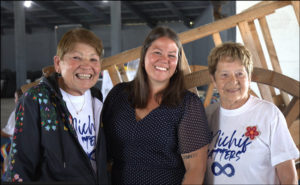
Lyla Phillips’ (centre) work as a Michif/Métis resource liaison sees her share values, culture and language with students and teachers. Photo supplied.
I am Lyla Phillips. I am originally from Rocanville but currently live in Saskatoon. My family connections are to the Desjarlais, Pelletier, Sayer and Friebus. My ancestors are from Rocanville, Moose Jaw, St. Francois Xavier and Red River. I am proud to be Michif. I am proud to speak Michif. I am trying to save my language, Michif. I enjoy spending time outdoors, traveling and visiting with my loving family. Additionally, I thrift for unique treasures, always make time for puppies, learn the beautiful Michif language, and I love, love, love being immersed in the vibrant Michif community.
I received my bachelor of education degree from the University of Saskatchewan through the Gabriel Dumont Institute’s SUNTEP in 2016. Throughout my life, I have always been proud of my identity and curious to learn more about my heritage. At SUNTEP, we focused on connecting and creating a community of learners centred around cultural education. One pivotal moment in my journey was a workshop with Michif speaker Norman Fleury. I found Michif fascinating and enjoyable when repeating phrases, which sparked my initial interest in Michif language. Afterwards Mooshoom Norman shared stories and memories of speaking Michif with my Grandpa Freeman (Edward Desjarlais). I needed to know more about what happened to Michif in my family; this began a journey, driven by a deep passion for reconnection, and for preserving and promoting Michif language.
Currently, I work with Saskatoon Public Schools as the Michif/Métis resource liaison. Over the years, I have held various roles within SPS, focusing on the inclusion of Michif/Métis content and perspectives. As the Michif/Métis resource liaison, I provide leadership and work closely with schools and classrooms throughout the division to embed values, culture and language throughout the curricula. The inclusion of Michif/Métis perspectives in education fosters a more inclusive and diverse learning environment. Many conversations about my culture become a chance for others to share about their culture(s). This helps improve student learning outcomes by providing them with a more comprehensive understanding of the world and promoting respect for all cultures.
Central Urban Métis Federation Incorporated, a Métis local in Saskatoon advocated for the creation of this role approximately eight years ago. This position has motivated me to learn language at a propelled rate and continue the path of language learning. I will always be grateful for their advocacy for language and cultural inclusion in schools. The connections fostered through this teaching position have created a sizable community of passionate educators who support one another. A great example of this is the fantastic Michif Language Camp that CUMFI hosts in August at Batoche.
As I embarked on my role, I recognized the necessity of deepening my knowledge of the Michif language. At the time there were Michif classes at the Friendship Centre. There I met Brousse Flammand (Bruce Flamont), a Michif speaker who has significantly contributed to my understanding and appreciation of culture and language. Brousse still supports class participants and me in various capacities. This shows that the creation of positions like this are needed as a catalyst for enhancing connections between schools and Michif/Métis communities.
My primary focus as the Michif/Métis resource liaison is sharing and promoting the Michif language, which comes from a delightful mix of Cree verbs and French nouns. There are less than 30 fluent Michif speakers in the world. Many speakers are determinedly working with learners to reclaim, teach, share and speak Michif. I am very fortunate to be one of these learners. I have learned that Michif language carries the values, traditions and humour of our culture; it has shaped our identity and connects us to our heritage. By weaving Michif phrases into hands-on cultural activities, my hope is to encourage even more Michif/Métis people to reclaim their language, begin to, and continue to speak Michif. It is such an exquisite language filled with love, honesty and humour. We need language and culture to thrive simultaneously to stay connected to the heart of who we are as Michif people.
Additionally, outside of my professional duties, I work within the community for other organizations and Métis locals across the province in language and cultural reclamation work. As a member of Gabriel Dumont Local 11, I have supported Michif language classes and projects. Through puppeteering as Michif Old One, Koohkoom Rose, we have tried to teach the youngest of learners Michif. Koohkoom’s better half, Mooshoom Joe, keeps parents engaged with his quick wit and funny jokes. I do this work to give back to the Michif Old Ones and the Michif community that guides me.
My hope is for our young ones to one day be linguistically, culturally and academically thriving because they see and know their culture is reflected in all areas of the curriculum. I often think of the joy, guidance, encouragement, amazement and pride speakers have for those who are learning Michif. I want all students to receive that level of support, regardless of their cultural background.
Through the role of Michif/Métis resource liaison, I have gained an understanding of the power of community connections, community advocacy and collaboration. The friendships and connections I have forged through Michif language are lifelong and have evolved into an extended family. Working with various stakeholders, including schools, locals and volunteers, has shown me that collective efforts can lead to significant positive changes.
Moreover, understanding and appreciating the advocacy of those who came before us is crucial. Their dedication and hard work have paved the way for future generations to continue making a difference. Being aware of their contributions and feeling grateful for their efforts inspires and empowers us to carry on their legacy, ensuring that our collaborative endeavours are both impactful and sustainable. I suppose that is why the Métis community is exceptionally supportive of Michif/Métis individuals striving to reclaim Michif language or cultural traditions. We have this way of uplifting one another and encouraging the talents or interests of good-hearted people in the community. We know there is still a lot of work to do and that it is never too late to start learning something new.
Kishchi maarsii for listening to my language learning journey. Kishchi maarsii to those who have dedicated their careers to revitalizing the Michif language and culture.
Practice and Hear Michif Online
Gabriel Dumont Institute’s Virtual Museum provide the opportunity to practice and hear Michif online. Have a visit to listen to and repeat some of the phrases.
Michif Greetings and Niceties:
- Taanishi – Hello
- Piihtikway – Come in
- Maarsii – Thank you
- Kaawapamitin – I will see you again
From Saskatchewan Teachers’ Federation Bulletin – Summer 2025