

Reviving Her Ancestors’ Voice
Louisa Fraser’s Journey to Reclaiming Cree and Teaching It to the Next Generation
By Sarah MacDonald, STF Communications
When Louisa Fraser, 88, teaches at awâsisak kâ-nîmîhtocik St. Francis School in Saskatoon, she is providing the students with something taken from her as a child: an opportunity to learn Cree freely and joyfully.
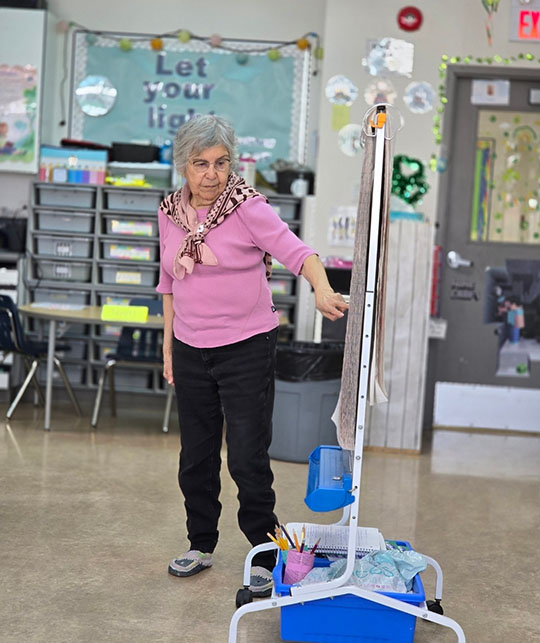
Louisa Fraser gains hands-on experience in the classroom
during her student-teaching practicum. Photo courtesy of Louisa Fraser
Cree was Fraser’s first language. She spoke it with her family and community on Mistawasis Nêhiyawak, a First Nation about 70 kilometres west of Prince Albert. But when she was about eight years old, she was sent to Birtle Indian Residential School in Manitoba where speaking Cree was forbidden. After four years in residential school, she attended the Indian day school at Mistiwasis Nêhiyawak for a few years and then went to high school in Prince Albert. Colonial school made her feel great shame about being First Nations and supressed her language.
But seven decades later, Fraser has learned Cree again and is determined to teach it to the next generation. “I always go back to my goal – to get my language back to be able to pass it on to other people,” Fraser says.
Fraser had long dreamed of teaching Cree, but until last year, she didn’t have an education degree. In her mid-80s, the great-grandmother returned to school to make that dream a reality.
Her journey to becoming a teacher was a long one. Along the way, Fraser held various jobs and earned multiple degrees and diplomas. She left Grade 12 a few credits short of graduating and worked for a time before marrying Samuel Fraser, a Métis man, and settling in a small town where they raised four children. She worked in hospital administration but soon realized that without post secondary education, her opportunities – and income – would be limited.
“As a child, I knew we were very poor on the reserve. After I came home from residential school and I was living on the reserve going to day school, we were in poverty most of the time. I knew I had to get an education so I could make my own living,” Fraser says.
She completed her high school diploma through correspondence classes and was accepted into a nursing program in Saskatoon. Although her family moved to the city to support her studies, she struggled and left the program after two years.
Fraser went on to work in various office roles, including at the Saskatchewan Indigenous Cultural Centre’s library, where she earned a library technician diploma. She later worked at a women’s halfway house and pursued a bachelor of social work degree through the University of Regina. “I did well in the classes. It was fairly easy for me,” Fraser recalls.
In 1994, at 56 years old, she got her first degree. She later completed a BA in sociology at the University of Saskatchewan.
She accepted some temporary social work jobs in Saskatoon and eventually landed a full-time job at the Battleford Tribal Council in North Battleford. “They paid me well, so I was able to get a mortgage, to get a car, and I got my driver’s license. I lived there during the week and came home on weekends,” she says.
Fraser worked there for six years, during which time she took a distance master of social work degree through Dalhousie University. “That was hard. I worked at the same time, so I really had to stay focused. I went to Halifax for convocation in 2007. That was the best day!” she recalls.
Her master of social work allowed her to open a private mental health therapy practice, which she ran from 2007 until 2021. Even then, her appetite for learning never slowed. A lifelong sewer, she enrolled in the Academy of Fashion Design in Saskatoon in 2019, earning a diploma two years later.
Around the same time, Fraser decided it was finally time to reclaim her language. Though already in her 70s, she was undeterred. She studied Cree during the summers for three years and earned a certificate in Indigenous Language Level 2 from First Nations University of Canada.
“I know what everything means. I can write Cree, but I’ve got to use the language more,” she says.
She wanted to share her knowledge of Cree, to think in Cree, and use it regularly, so she decided to become a Cree teacher. She applied for a teaching certificate, but since she still didn’t have an education degree, she worked as an education assistant instead.
Meanwhile, her granddaughter, Kelsey Fraser, was studying education through the University of Saskatchewan’s Indian Teacher Education Program. Inspired by the program’s focus on Indigenous cultures and languages, Fraser enrolled after Kelsey graduated, beginning classes in September 2023.
“I was really excited and happy for her because when I was in the ITEP program, my grandma would tell me, ‘I’ve always wanted to get to be a teacher.’ And I said, ‘Well, why don’t you just do it?’” recalls Kelsey, who teaches grades 3 and 4 at an Indigenous-focused elementary school in Calgary.
Initially, Fraser found the program a bit daunting. She was the only white-haired person among many fresh-faced students and some who were in their 30s and 40s. Education classes were quite different from social work, and the new technology was challenging. Still, she found comfort in learning alongside other Indigenous students, some of whom also spoke Cree.
“I always went back to my goal to get my language back to be able to pass it on to other people. That’s what kept me there,” explains Fraser.
Many of her previous university credits applied to the B.Ed. so she finished the degree in two years. She did her practicums in Saskatoon at wâhkôhtowin School and awâsisak kâ-nîmîhtocik St. Francis School, which both have Cree programs. At University of Saskatchewan’s fall 2025 convocation, she was the oldest graduate – and received a standing ovation from her classmates.
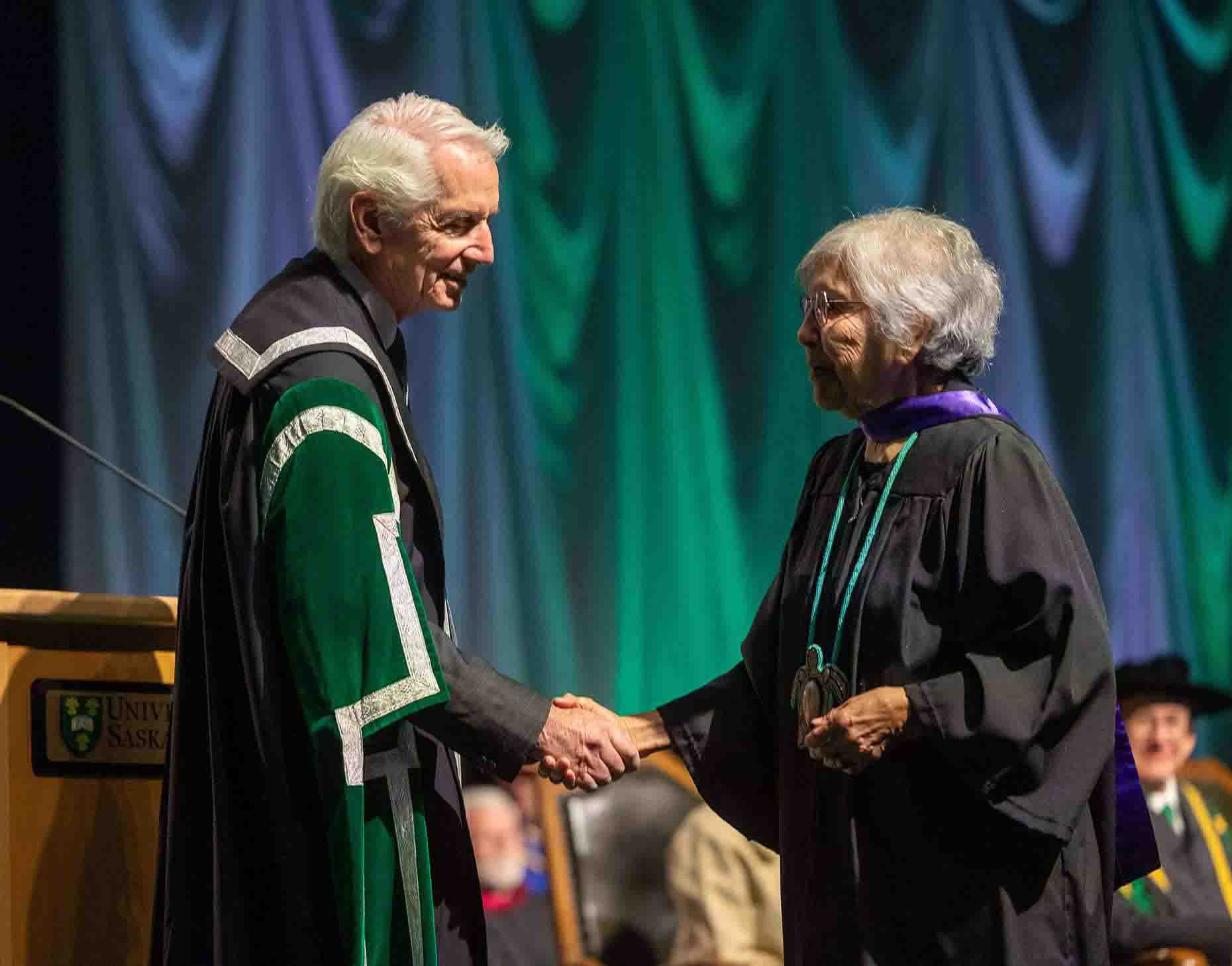
Great-grandmother Louisa Fraser is the most recent person in her family to get an education degree. Her daughter Kim Fraser-Saddleback, her niece Valery Harper and her grandniece Shawn Sanderson all have doctor of education degrees from the University of Saskatchewan. Kim teaches at First Nations University of Canada. Her granddaughter Kelsey Fraser is also an ITEP graduate, and she teaches at an Indigenous-focused school in Calgary.
Louisa Fraser receives her bachelor of education degree from
the University of Saskatchewan. Photo: University of Saskatchewan
Today, Fraser is living out her dream. She works as a substitute teacher with Greater Saskatoon Catholic Schools, teaches Cree syllabics to current ITEP students and serves as an Elder in the program. She is also exploring online Cree teaching and parent-focused language programs.
Kelsey has watched her kokum teach and says it comes naturally.
“I wish to be a student in her class because I know that she’s soft-spoken and when she smiles you feel so safe with her. The kids are well behaved with her because it’s like having your kokum in your class and you listen when your kokum is around,” Kelsey says.
While many people her age are long settled into retirement, Fraser is embracing a new chapter. Alongside sewing, reading, Elder work and exercise classes, she now teaches several days a week.
“I just want to get more experience in the classroom. It’s always in the front of my mind that I want to pass the language down, so people use their language all the time, wherever they are, at school, at home or in a community,” she says.
Fraser, who has long been an inspiration to Kelsey and others in her family thanks to her work ethic and constant desire to learn new things, says that it doesn’t matter how old you are; you can always go after your dreams.
“Even if it’s hard, if you really want it, you can put the time into it, to work on it, to complete it. Maybe it is inspiring, but I just wanted my B.Ed. so I could teach Cree,” she concludes.
For Kelsey, her kokum’s work represents healing.
“She didn’t get to be in a classroom setting where you could learn your language and play with your friends and have a day filled with adults who care about you and honour you,” says Kelsey. “I know that it’s healing part of her and that’s a beautiful way of revitalizing both her language and her spirit.”
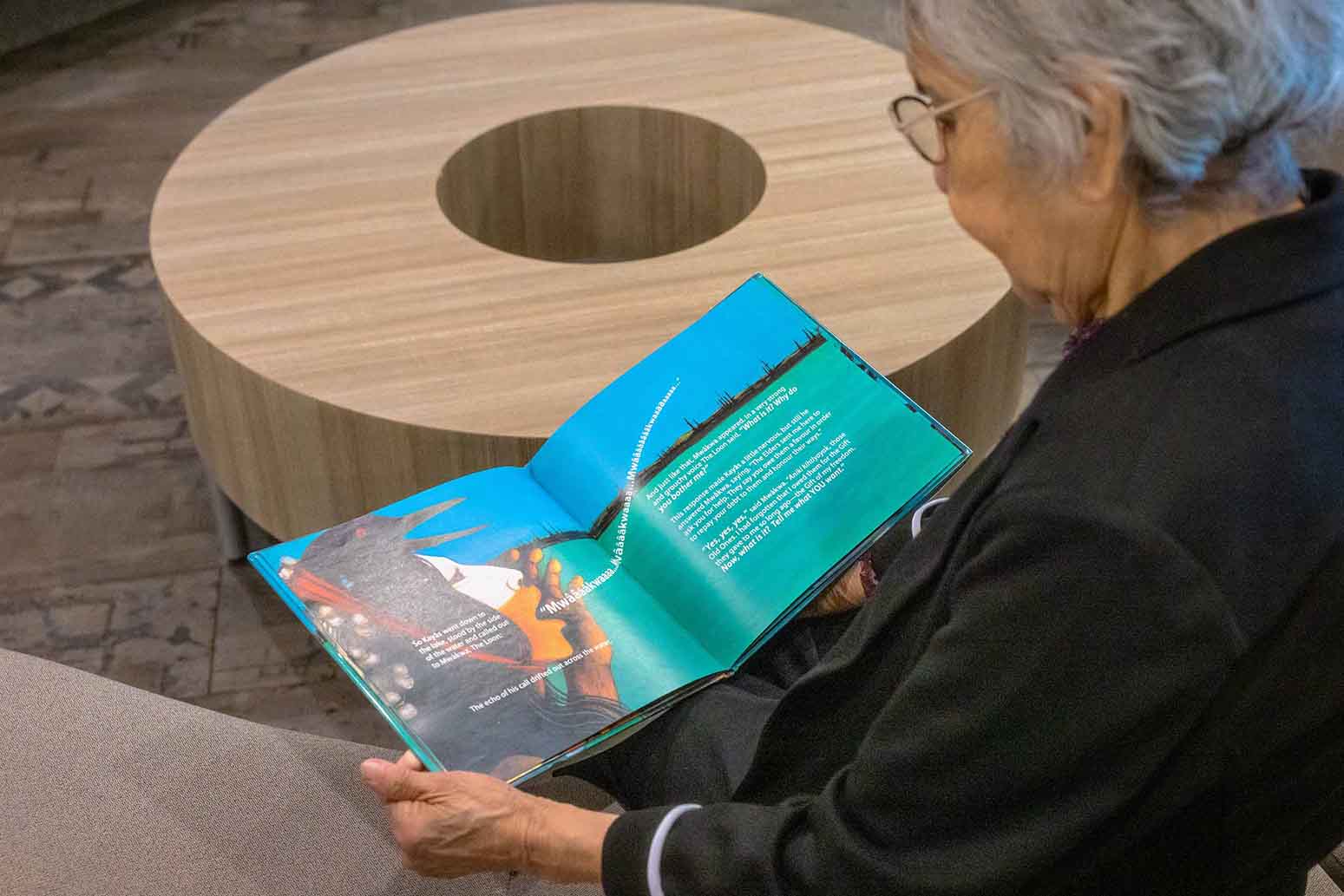
Photo: Jordan Trask
From Saskatchewan Teachers’ Federation Bulletin, Summer 2026