

Rooted in Connection: A Journey to Inspire Indigenous Ways of Learning
By: Jana Len, STF Bulletin Contributor
What began as two teachers wanting to deepen their personal knowledge has grown into a division-wide initiative, reshaping the way students across Prairie South School Division experience learning.
Principal Jill Tressel and vice-principal Melissa Brooks of King George Elementary School in Moose Jaw have embraced the true meaning of community building and knowledge sharing through their work to integrate Indigenous ways of learning into classrooms. They continue to work to share those lessons with the broader community.
The journey began after Tressel and Brooks attended a professional learning session led by Denise Heppner, associate director of STF Professional Learning. She introduced them to the 8 Ways of Indigenous Learning and Pedagogical Framework, a tool designed to support teachers who want to include Indigenous perspectives in their classrooms by using Indigenous teaching techniques.
For the two teachers, the session was more than a professional development exercise. The framework became a guide to rethink how education could look and feel, not only in their school, but also within their community.
Rather than treating the session as a one-time experience, Tressel and Brooks were determined to integrate what they had learned. They added a new lens to their teaching, one that emphasized hands-on engagement, student involvement and building connections with the community.
Their first project was creating an outdoor teepee classroom. The project quickly became more than a physical structure as it evolved into a gathering place for students, a space for shared learning and a point of connection for the community.
Students involved took responsibility for teaching others about the teepee, explaining its cultural significance, the importance of storytelling and impact of Indigenous artwork. The project embodied the principle of “living and learning” and moving beyond passive listening to active participation.
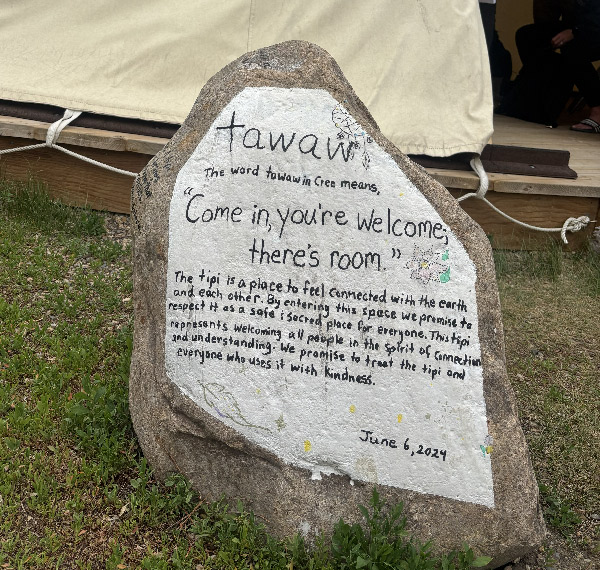
Stone display highlighting the importance of the teepee and the Cree word “tawa,” meaning “come in, you’re welcome, there’s room.” Supplied photo.
With support from colleagues and guidance from community members, they developed the vision for an Indigenous Ways of Learning Day.
After seeing the impact of the teepee construction and outdoor classroom, Tressel and Brooks knew they could broaden the experience. With support from colleagues and guidance from community members, they developed the vision for an Indigenous Ways of Learning Day.
“We received such a positive response from teachers throughout the division,” says Tressel, “we had to narrow down the attendees to those in Grades 4 to 6 to ensure we could accommodate the interest safely and effectively.” After months of planning, King George Elementary School welcomed an additional 400 students from across the division. The schoolyard was transformed into a living representation of the framework that had inspired it all.
Including the 8 Ways of Learning, a total of 13 stations were set up, each focusing on a different aspect of Indigenous learning. At every station an expert with lived experience shared teachings and information. Students were encouraged to reflect on what they had learned and consider how they could bring those lessons back to their schools, communities and daily lives.
The event began with a very special land acknowledgement created specifically for the school. Students were central to the planning and execution of the entire event. Each student involved had a role and responsibilities that ensured the day’s success. Through this work, students gained experience reaching out to the community and collaborating with artists, Elders and Knowledge Keepers.
Highlights were a performance by Regina’s Buffalo Boys Drum Group and a round dance that concluded the day. These performances reinforced that culture is shared, communal and celebrated together. Brooks says that “for students, seeing peers perform and share their own traditions created really powerful connections.” These experiences remind everyone that education is not limited to textbooks. It is about building community, relationships and identity.
A key focus for Tressel was the belief that learning is not meant to be kept to yourself; it is meant to be offered and shared with others. This principle guided every decision in planning the event.
The day reinforced the idea that knowledge grows and circulates through connection. Each class took responsibility for learning about one aspect of the framework and then teaching it to others. Brooks emphasizes the importance of connecting with those in the community who have lived experience. “By having their knowledge, it allows you to take risks and explore new opportunities for learning,” she says.
Working with their colleague Cassidy Budd, a First Nations teacher committed to the project, Tressel and Brooks ensured their actions were guided by positive intent and authenticity, while respecting and honouring Indigenous culture.
The risks taken proved worthwhile. Teachers from other schools shared positive feedback, noting how much their students had learned and how they were able to bring lessons back to their own classrooms and schools. Most importantly, students expressed immense pride in their involvement and in being part of such an inspiring day. The impact will continue through their actions and reflections.
For Tressel and Brooks, the most meaningful outcome has been the relationships formed. Elders, artists and community members have become partners and friends. These relationships have deepened, creating common ground for shared learning.
The Indigenous Ways of Learning Day is not a one-time initiative. It is the beginning of a continuing journey for staff and students at King George School. Since the event, the school has developed a student leadership group that meets monthly, bringing together students to collaborate and share ideas on how to continue the learning. This group will play a central role in shaping future events, ensuring student voices remain at the heart of the process.
Planning is already underway for the next event later this spring. While details are still being finalized, the vision is clear – continue building connections, sharing knowledge and taking risks to enhance learning.
The framework introduced by STF Professional Learning is guiding the effort and will continue to shape the focus and impact of future events. With a focus on connection, students and staff demonstrate how education can be transformed when relationships are prioritized. When people come together with respect and intent, learning becomes more than classroom instruction. It becomes lived, shared and impactful. The lessons learned will stay with students long after they leave school, shaping how they connect with others and contribute to their communities.
Connections are the foundation of learning. They bridge cultures, strengthen relationships and create pathways to a stronger future together. The staff and students of King George School will continue along their journey to implement Indigenous ways of learning into their day-to-day lives.
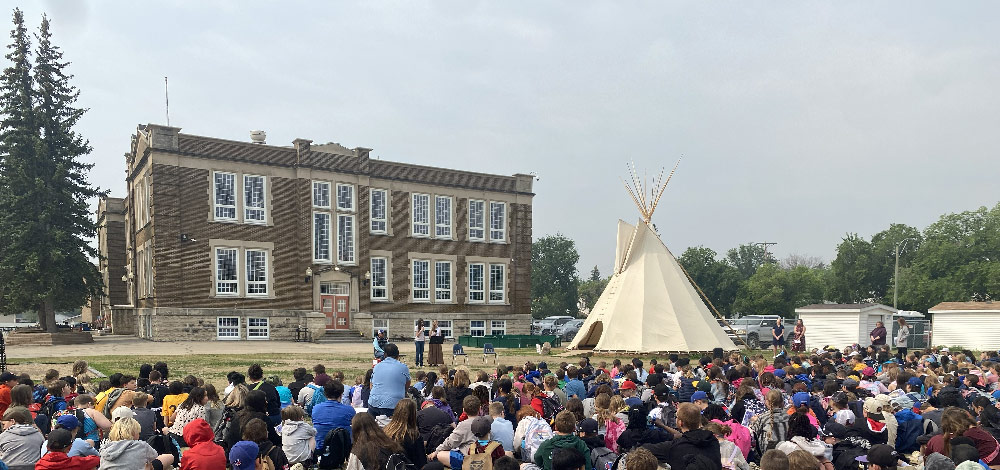
Students gather in front of a tipi on the lawn of King George Elementary School in Moose Jaw. Photo supplied
The 8 Ways Framework
The 8 Ways Indigenous Learning and Pedagogical Framework guides teachers to include Indigenous perspectives through the use of Indigenous learning and teaching techniques. It’s meant as a culturally safe entry point to begin engaging with Indigenous knowledge. Learn more in the Winter 2023 edition of the Saskatchewan Bulletin.
- Story Sharing: learning through narrative. (We connect through the stories we share.)
- Learning Maps: planning and visualizing explicit processes.
- Non-Verbal: working non-verbally with self-reflective, hands-on methods.
- Symbols and Images: learning through images, symbols and metaphors.
- Land Links: learning through place-responsive, environmental practice.
- Non-Linear: using indirect, innovative and interdisciplinary approaches.
- Deconstruct/Reconstruct: modeling and scaffolding by working from wholes to parts.
- Community Links: Connecting learning to local values, needs and knowledge; also refers to classroom community.
Sources
Regional Aboriginal Education Team (RAET). (2023). 8 Aboriginal Ways of Learning. https://www.8ways.online/.
Yunkaporta, T. (2009). Aboriginal Pedagogies at The Cultural Interface. Our Ways of Learning in Aboriginal Languages. https://researchonline.jcu.edu.au/10974/.
From Saskatchewan Teachers’ Federation Bulletin – Spring 2026