

Saskatchewan Government’s Budget Leaves Students Behind
REGINA – Saskatchewan teachers are deeply concerned that government has abandoned its commitment to public education.
“Budget 2026 does not address the continued challenges students face in Saskatchewan schools each day,” says Saskatchewan Teachers’ Federation President Samantha Becotte. “Despite Premier Moe constantly listing education as a top priority, he failed to deliver on his own commitments with this budget. Budgets reflect values and priorities. Today, this government has shown it does not value public education.”
Today’s budget provides a 2.6 percent increase in operating funding for school divisions. With at least 2.5 percent needed to cover rising costs and with the government assuming enrolment of an additional 700 students, this allocation represents an inflation-adjusted decrease of $33 per student compared to the previous year.
“With the government touting Saskatchewan as the strongest economy in Canada, why then are we not investing in the children that will keep us strong into the future? This is a short-sighted approach that ignores the fact that education works to build our province,” says Becotte.
While last year’s budget provided an increase of 8.4 percent, the majority of that increase was due to the province’s legal obligations in the 2023-2026 Provincial Collective Bargaining Agreement, which were achieved through binding arbitration after historic teacher job action.
“As a direct result of teachers’ dedication and collective action in the last round of bargaining, there are an additional 500 teachers in Saskatchewan classrooms and $20 million available per year to school divisions in a class complexity fund,” says Becotte. “Teachers, students and parents fought hard for those improvements for students. We had hoped this budget would reflect government’s promises and demonstrate a willingness to invest in public education.”
Students’ learning environments continue to be negatively impacted by inadequate funding, resulting in large class sizes, complex classrooms and limited access to specialized supports.
“We are preparing to enter a new round of bargaining this spring. Teachers were watching Budget 2026 as an indication of how the government may approach this round. Teachers will always bargain in good faith and be focused on reaching a negotiated deal; however, today’s budget has shown students, parents and teachers the only way this government will invest in public education is if it is forced through immense public pressure, legal obligations and the loss of seats. Today’s budget should be viewed by students, parents and teachers as a failure and broken promise of this government.”
The STF continues to call on the government to restore inflation-adjusted per-student funding to 2015-16 levels of $13,865 by the end of its current term. Per-student funding in 2026-27 is projected to be $12,311, which represents a $1,550 gap compared to 2015-16.
The STF invites all teachers, parents, students and those who know students deserve better to visit Tell Them Tuesday and join the movement for better schools.
Backgrounder
Inflation-Adjusted Per-Student Funding
- When adjusting for inflation, Budget 2026 reduces per-student funding to $12,311 for the upcoming school year.
- This represents a gap of over $1,550 per student compared to the 2015-16 level of $13,865 (adjusted for inflation).
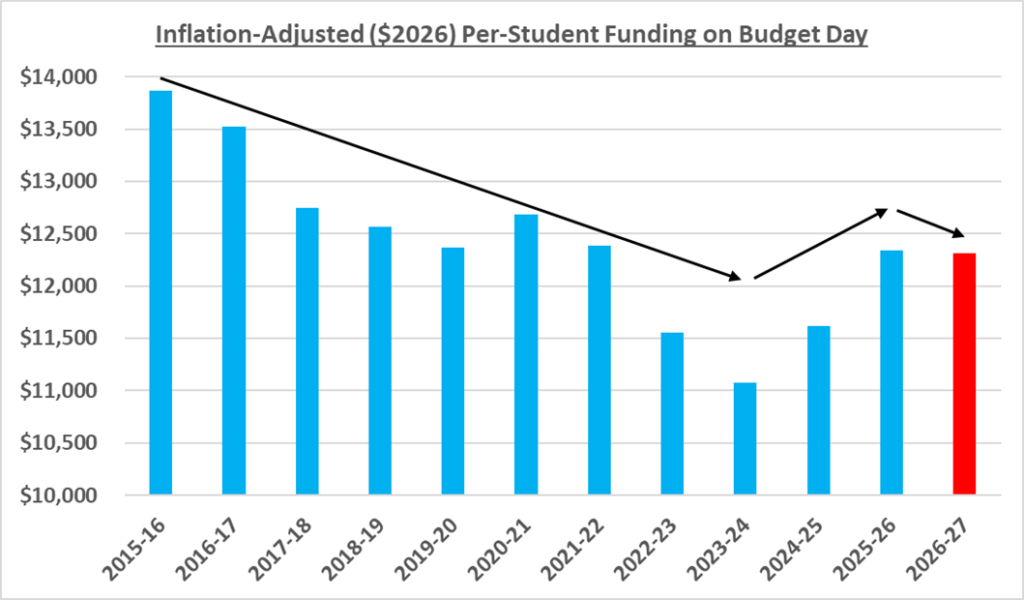
Sources: Government of Saskatchewan, Publications Centre, Ministry of Education: Provincial K-12 Student Enrolment Summary reports: Publications Centre
Government of Saskatchewan, Publications Centre, Ministry of Education, School Division Operating Funding Allocations on Budget Day reports: Publications Centre
Statistics Canada. Table 18-10-0005-01 Consumer Price Index, annual average, not seasonally adjusted.
Note: Ministry assuming enrolment growth of 700 students in 2026-27.
Increase in Per-Student Funding in 2025-26 Due to Teacher, Parent Advocacy
- Budget 2025 allocated $2.41 billion in total operating funding to school divisions, representing an increase of $186.4 million (8.4 percent) over the previous year’s allocation.
- The majority of this increase was due to government’s legal obligations in the 2023-2026 Provincial Collective Bargaining Agreement, which were secured through binding arbitration following historic teacher job action.
- The $186.4 million increase was comprised of:
- $131.3 million to fund the new PCBA and address enrolment pressures;
- $53.1 million to address non-teacher salary increases, transportation and inflation, and to implement 50 new specialized support classrooms (government committed to 200 over four years); and
- $2.0 million for K-3 literacy (allocated outside the Ministry of Education operating grant).