

Creating a Spark: Trades Education is Unique Learning for Teachers, Students
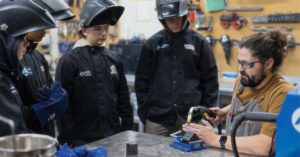
Grade 10 students (left to right) Rhett Nosterud, Ken Dela Cruz, Matthew Hodgson and Corbin Bakken watch as teacher Jon Forbes demonstrates proper welding technique. (Jordan Trask/STF Photos)
By: Rod Drabble, STF Communications
For a moment, you can hear sandpaper whispering on wood across the shop as Jon Forbes watches a student set up the router table.
“There it is, nice and tight,” Forbes says, as the student turns the wrench to lock a raised panel bit into place.
The quiet is broken by the whir of the router. Then the screaming starts as the bit carves a path along the lid of the student’s box project. Forbes indicates approval and keeps moving. He grabs a battered, paint-spattered stool and sits down at a table. Students’ eyes turn toward him for a demonstration of how to clamp the box for gluing.
“Makes sense?” he asks, looking around the table. Five heads nod together.
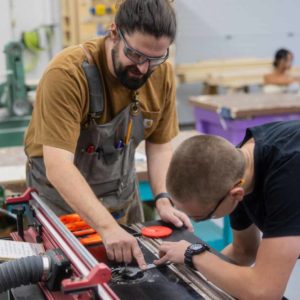
Teacher Jon Forbes watches student Ryder Loewen set up the router table in the woodshop at Martensville High School.
It’s a familiar routine for Forbes, a practical and applied arts (PAA) teacher at Martensville High School. He’s constantly on the move demonstrating, answering questions and praising the work of Grade 10 students in the woodshop and adjacent welding lab.
As a Red Seal carpenter and a teacher who majored in industrial arts while attending the University of Saskatchewan’s College of Education, Forbes brings a special skillset to teaching. Not surprisingly, he is an advocate for the benefits of PAA education for students.
“It’s a really good link between knowledge and skills,” he says. “We do a project and it takes them half a semester. There aren’t a lot of things they can do anymore that don’t give them instant gratification. It’s a good bridge for them; they get that (immediate) feedback but also the long, drawn-out satisfaction at the end.
“It’s an area where sometimes kids see a lot of success when they don’t see a lot of success in other parts of school. They just need to find something they are interested in.”
There are 35 curriculum areas beneath the PAA umbrella in Saskatchewan. There are many familiar, long-standing courses in trades and home economics, but other areas include agriculture, business, communication and design, human services, resource management, and career and life management.
Programs such as construction and carpentry and welding are examples of trades programs that are well known to generations of students but also evolving to meet today’s needs.
“A lot of people still call it industrial arts or vocational but today applied technology is a perfect descriptor for the bridge between trades and technology,” says Kelly McIntyre, a high school teacher in Maidstone and president of the Saskatchewan Teachers of Applied Technology. “We all know that technology plays a role in everything we do today, but how does that vary across different trades? While some tasks have been automated, in the end, we still rely on skilled tradespeople.”
No matter the term you use – shop, industrial arts or PAA – teachers in trades and technology are unique within their schools. Large, urban schools may be able to designate a full-time teacher for a single subject area, but the reality is many teachers have to be proficient in several widely different areas.
“It’s very broad. When you try to explain to people what you teach, it’s probably easier to say what don’t I teach,” explains McIntyre. Often, PAA teachers offer survey courses where two, three or more areas are linked to provide students with a richer experience.
That diversity is one of the reasons why McIntyre believes in the value of STAT and its 80-plus members. She says PAA teachers across the province – whether members or not – are generous with each other. They share knowledge and experience around effective teaching as well as strategies to ensure the ongoing success of programs in their schools.
“We are our greatest resource,” she says. “What I love most about STAT is that I’ve never met a group of people so open about sharing their resources and so full of tried-and-true tips and tricks for their teaching spaces. The learning at STAT is truly unique.”
As a professional growth network, STAT welcomes teachers from all backgrounds. Its conferences are filled with active, hands-on learning in areas such as glass blowing, jewelry making, blacksmithing, cabinet making, 3D printing, epoxy work, Teepee Teachings and more.
“You don’t have to be a shop teacher to attend,” McIntyre says. “Educators from all subject areas can find valuable learning here.”
There are several challenges in Saskatchewan when it comes to teaching PAA and trades-related courses, according to McIntyre. First, many programs require a significant capital investment in tools and machinery and funds to maintain equipment.
“PAA programs are costly to run, so without someone who truly values them within your own school, they often go unfunded and end up being the first to be cut. When that happens, kids lose the chance to be exposed to trades early on.”
Like other classrooms, trades-related classes have experienced growth in enrolment and diversity. More students means a greater focus on safety while also ensuring shops are as accessible as possible. McIntyre points to one student who was extremely noise sensitive. In the past, woodshop may not have been an option, but noise-cancelling headphones, a gradual introduction to the skills and the use of hand tools instead of roaring machines made learning possible.
“This is a life skill,” she says. “If we can create something that is a life skill and make that connection, that’s fantastic. We just need to have that support there.”
Access to formal training is another challenge. Industrial arts certification through the University of Saskatchewan’s College of Education is on pause and programs are few and far between in Canada.
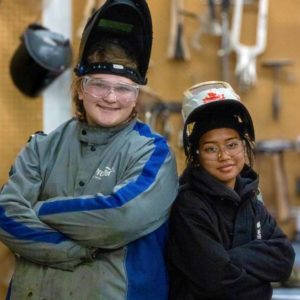
Abbey Hart (left) and Raylai Lint don heavy jackets and eye protection in preparation for welding. Safety is an important part of the learning for students.
Forbes’ combination of a teaching degree in industrial arts and journeyperson ticket offers him a special perspective. He has previously taught courses such as math and psychology in addition to PAA, but the opportunity in Martensville to focus on shop classes has strengthened his teaching practice.
“Having a really deep level of knowledge makes teaching in that area a lot easier,” he says. “It doesn’t always need to be you at the front and everyone doing things at the same time. There are a lots of teachable moments. To somebody who just walks by and looks in the classroom, sometimes it looks like absolute chaos, but I tell people when they come in, this is not going to look like a normal classroom, and that’s okay.”
McIntyre’s best estimate is there are perhaps 100 fully certified PAA teachers in Saskatchewan schools, but there are also many teachers who recognize the value of trades and have stepped up to make sure that programs are still available for students.
“There are even a few teachers who may be hobbyist woodworkers or something and they have been gracious enough to take on the shop position in their building despite not being a shop teacher,” she says. “I think that is so courageous. It is very intimidating; it is not a space that just anybody can walk into and feel comfortable.”
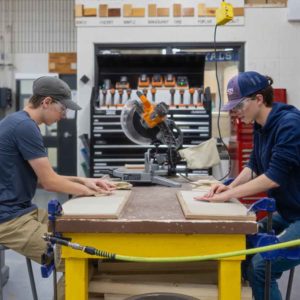
The practical and applied arts program at Martensville High School introduces students such as George Krueckl (left) and Zachery Swanson to woodworking.
With Canada facing a generational transition and a forecast decline in workers in trades-related professions, skilled teachers can play an important role in introducing students to the trades and perhaps inspiring a career.
“I love it, seeing their light-bulb moments, seeing them start to piece it together,” Forbes says. “I am passionate about it because I grew up in a smaller town where I had a really great shop teacher. My job as a shop teacher is not to put out carpenters or welders. My job is to show them what they can do and create interest and knowledge so when they go off to learn it for a career, or whatever it might be, they have good, solid foundational knowledge.”
McIntyre believes in the value that trades and technology learning has for students. But as someone who twice left the classroom to return to a trades career and then came back, she also knows firsthand the impact that working with students has on teachers.
“I had to come back because I missed working with kids. At the end of the day my most fulfilling thing is seeing a kid who was unsure if they could build something and then they build something themselves and you see that pride. There is perhaps nothing more fulfilling than that,” she says.
“Building relationships with our students is primary before any learning can ever happen. That is, hands-down, the biggest and most effective tool in education no matter what we are teaching.”
From Saskatchewan Teachers’ Federation Bulletin – Winter 2025