

Taking Reconciliation Out of the Classroom
By: Sarah Macdonald, STF Communications
It’s not every day that Grade 3 and 4 students get to play with hatchets and fire in the schoolyard. Then again, it’s not every day that they get to learn Indigenous teachings from the land. But if it were up to Laurie Sneddon, a Grade 4 teacher at Battleford Central School, it would happen a lot more often.
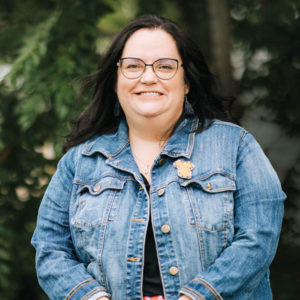
Laurie Sneddon, a Grade 4 teacher at Battleford Central School, incorporates Indigenous ways of knowing and doing into her teaching. (Jordan Trask/STF Photo)
Sneddon, who has been teaching since 2000, has been integrating more and more First Nations and Métis content into her classes. When she started her career, there were very few Indigenous resources, and the curricula glossed over Indigenous perspectives. But as Canadians address the dark history of colonization and residential schools, there has been a noticeable shift. Now children are learning about Indigenous people in their classes, and if they’re lucky, like those at Battleford Central School, in the schoolyard, too.
“I think that learning from the land and having fun doing it is part of understanding different cultures and that’s part of what we want to do for reconciliation in an elementary setting,” Sneddon explains.
For Sneddon, incorporating Indigenous ways of knowing and doing into her teaching is also part of a more personal journey. Her mother’s family is Métis from Red River and Turtle Mountain, but due to discrimination, her grandmother was raised to say she was Spanish and was not taught any culture or history. Recently, Sneddon, her siblings and her mother began exploring their Métis roots, taking pride in what was once considered shameful. “The more I discover, the more I can share with my students,” Sneddon says.
Now she teaches her students how to bead and do Métis finger weaving and takes them to powwows. Two years ago, she introduced Bannock Day to the school, which has approximately 35 percent of its students self-identifying as Indigenous. This year she expanded it to be the Bannock and Fire Teachings Day and invited Anishinaabe Knowledge Keeper Barry Shingoose, a member of Cote First Nation in Treaty 4 Territory, to lead the teachings.
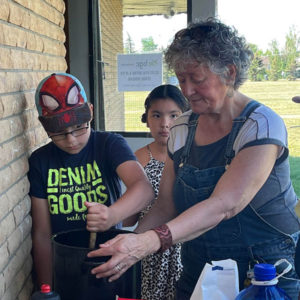
Sherron Burns, the Indigenous education consultant for Living Sky School Division, works with students to make jam. (Photos courtesy Laurie Sneddon)
The Grade 3 and 4 classes spent a day last May learning to make a fire while listening to Shingoose share First Nations teachings about fire. Then, with the help of Sherron Burns, the Indigenous education consultant for Living Sky School Division, they made chokecherry jam and Bannock over the fire.
Shingoose is a former middle school teacher who now has a consulting company, Indigi-Nist Consulting, through which he shares Indigenous perspectives of science, math and astronomy, which are embedded in First Nations cultures. He learned his teachings from his grandfather and from other Elders and Knowledge Keepers in Saskatchewan. His work has taken him to 58 of the 74 First Nations in the province. “I get an opportunity to sit with Elders and Knowledge Keepers and learn stories from their perspectives or their community. I hold a lot of knowledge to my heart,” Shingoose says.
Shingoose showed the students each step of making a fire, from finding a good place to build it, to gathering tinder, cutting kindling and logs with a hatchet, and lighting it with a steel and flint. As he demonstrated the steps, he spoke of how some First Nations people compare a fire to one’s life. Where you build your fire is like the foundations of life. The tinder is symbolic of the values one learns as a child. The kindling represents one’s teenage years. The logs are adulthood. Each stage impacts the next.
“It’s really interactive and fun for them because they’re just sitting there listening and watching me actually build a fire. Then I tell them, just like in life, if you have everything built right, what will happen to the fire? If you were raised with good values, if you live a good life, then your life is going to be lit up like a fire. That’s what they call our home fire,” he explains.
Shingoose also shares how First Nations people view fire as an element, a spirit and a helpful gift from the Creator. He speaks of the strong connection between women and fire in Cree culture; the Cree word for fire, iskotew, is derived from the word for woman, iskwew.
Another teaching related to making a fire is one about teamwork. First Nations people were traditionally very cooperative and worked together in their communities. Battleford Central School students who didn’t always get along well were put in the same group and had to figure out how to communicate and collaborate to build their fires.
Astronomy also features in Shingoose’s Fire Teachings. “I link it to the Seven Sisters (Pleiades) constellation, because that’s representative of fire, too, or representative of the Seven Grandfathers, the rocks used in a sweat lodge,” he says. The Anishinaabe call the seven stars Madoo’asinug, or “Sweating Stones.”
Shingoose went to elementary school in Yorkton in the 1990s and he was one of two Indigenous children in his class. Racism, stereotyping and discrimination were prevalent. He has noticed a shift as he visits schools around the province. Now the Indigenous children take pride in the teachings and the ceremonies.
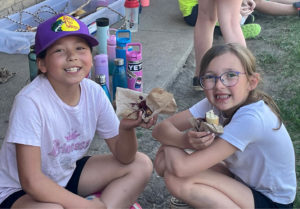
Students enjoy bannock with jam as part of Bannock and Fire Teachings Day.
For the Battleford Central School students who participated in the Bannock and Fire Teachings Day, the lessons will be lasting. Mallory Hellofs, a Grade 4 student, says the day made her really think about Indigenous Peoples’ ways of life and beliefs. She is also grateful for the practical skills she learned and thinks she will be able to share them with her family.
“It was really cool because [Mr. Shingoose] would, like, really share everything. He wouldn’t leave a detail out,” she says.
Sneddon encourages teachers to try more hands-on activities to integrate Indigenous knowledge into their classes, whether they’re Indigenous or not. She says they can start out small, be open to learning, and reach out to Indigenous people like Shingoose to help them. She says there are many ways that the teachings can fit into Western curricula, too. The Bannock and Fire Teachings Day touched on health, social studies, math and English language arts, as the students had to write little poems summarizing the day.
Sneddon, who grew up on a farm north of the Battlefords, has also seen more acceptance and even celebration of Indigenous culture in Saskatchewan. From learning to deny her Indigenous roots as a child, to starting her Bannock and Fire Teachings Day with a tobacco offering and a smudge, she is happy that children get to participate in reconciliation firsthand by learning Indigenous ways of knowing and doing.
“Our children all know the story for Orange Shirt Day and residential schools. We’ve worked very hard on making sure they understand that. We’ve done amazing art installations based around it. We’ve read the stories, and we’ve had the discussions. But I think this added to the idea that reconciliation isn’t just that day; it’s a much bigger idea,” Sneddon says.