

Turning Words Into Action: 2023-2026 Provincial Collective Bargaining Agreement Implementation
By: Lance Hiltz, STF Communications
Implementation of the 2023-2026 Provincial Collective Bargaining Agreement has been keeping the education sector busy for the past several months. The Agreement is a major milestone for teachers and public education after a contentious round of negotiations that saw the longest stretch of job action ever by Saskatchewan’s teachers.
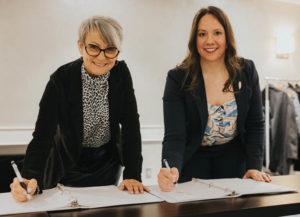
STF Executive Director Angela Banda (left) and STF President Samantha Becotte sign the 2023-2026 PCBA. (Jay Salikin/STF Photo)
Signed by the Teachers’ Bargaining Committee and Government-Trustee Bargaining Committee last spring, after an arbitrator decided in favour of teachers’ position on including provisions to address classroom complexity, the Agreement includes several new provisions that directly address classroom complexity. Most notably, approximately 515 permanent new teaching positions will be added to schools across the province, and an additional $20 million per year in new funding is earmarked to address classroom complexity.
“The last round ended well for us, with finally getting classroom complexity into the Agreement. That’s a battle that we don’t have to fight going forward,” says STF Associate Executive Director, Labour Relations Patrick Maze. “Now we can focus on implementation to ensure the changes are having the intended effect. Knowing we are back at the bargaining table in May of 2026, we will be gathering feedback from members to see what is working and what requires further changes.”
Over the last decade, classroom complexity has intensified in Saskatchewan schools as a direct result of increased needs among the growing student body and the provincial government’s underfunding of the public system. With the implementation of the Agreement, every school with a student population over 150 gets a full-time certified teacher, and every school with a population of 75 -149 students gets a half-time teacher, assigned to address classroom complexity. The duties of these teachers “may include, but are not limited to, one-on-one behavioural/safety interventions, individual or small group programming to address specialized learning needs of students, acute learning needs, modifications or adaptations of programming, counselling services, self-regulation education” and more, as per article 17.3.1 of the 2023-2026 PCBA.
“Having a dedicated, go-to person in the school who does not have a classroom assignment and can be relied on to intervene and assist students with complex needs should make the learning environment better for teachers and students alike. We will be able to begin addressing some of the problems that we have heard about for years and long advocated solutions to,” says STF Executive Director Angela Banda.
“We know that we are facing a teacher recruitment and retention issue in Saskatchewan and it may be challenging in some locations but the expectation is that school divisions must do their very best to fill these positions,” says Banda. “If divisions have issues hiring, there is a measure in the Agreement that allows them to hire other professional classroom supports for this fall.”
This measure is intended to help with implementation in the near-term, and the STF will be closely monitoring how and where this is used. Despite the GTBC’s insistence during bargaining that there is no teacher shortage, concerns about teacher recruitment and retention were part of the TBC’s original proposal package from the onset of the last round of bargaining.
For the Teachers’ Bargaining Committee, one concern regarding implementation that has already surfaced is the funding for government’s Specialized Support Classroom pilot project. Government announced this project during the bargaining round, which the TBC believes was an attempt to subvert teachers’ efforts to get classroom complexity into the collective agreement. The Ministry has indicated that the PCBA is fully funded, yet the Special Support Classroom project funds allocated to school divisions do not include full funding. The government has suggested that an SSC teacher can be one and the same as the class complexity teacher in a school.
“For the government to say that their specialized support classroom teachers will be considered the classroom complexity teachers for the schools involved in their pilot program is wrong and not in the spirit of the Agreement,” says Banda. “We have communicated this to government, and we are looking at various ways to challenge it in instances where they are not in fact properly funding their specialized support teachers.”
Regardless, the STF recognizes that any additional funding to support teaching and learning is valuable. Addressing the issue of classroom complexity needs to take a variety of forms and the STF is confident that school divisions will implement both initiatives in accordance with what is best for students and teachers.
According to The Education Act, 1995, teachers are expected to be back at the bargaining table in May of this upcoming school year. For the STF, there is an ongoing, continuous cycle of work related to bargaining: organization and preparation, negotiations, implementation and evaluation. The Federation is always engaged in some part of the cycle, whether it is a bargaining year or not. The STF Executive appoints members of the Teachers’ Bargaining Committee annually, during their August meeting. This year’s new TBC members will quickly join in. Preparations are already well underway and will continue. This includes appointment of the new TBC, collecting member feedback, developing strategies, and assembling a proposal package for STF councillors to vote on during their Annual Meeting of Council in spring 2026.